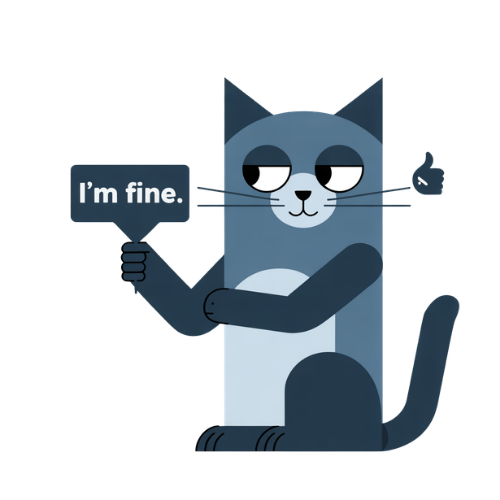
You ask if everything is okay. They say "I'm fine" with a smile that doesn't reach their eyes. The dishes get washed louder than necessary. The plans you made get "forgotten." A "joke" lands a little too sharp at dinner with friends. When you bring it up: "You're being ridiculous. I said I was fine."
This is passive-aggression — and what makes it so exhausting is that you can't fight it directly. Every time you name it, the surface evaporates. The whole structure depends on plausible deniability.
What is passive-aggressive behavior?
Passive-aggressive behavior is the indirect expression of hostility. Anger, resentment, or refusal that comes out sideways: through silence, sarcasm, deliberate inefficiency, "forgetting," or compliance laced with subtle defiance. The hostility is real; the channel is muted enough that it can be denied if confronted.
The term entered psychology in the 1940s when U.S. Army psychiatrist William Menninger noticed soldiers who couldn't refuse orders directly but resisted indirectly — through stalling, sloppiness, and "accidental" forgetting. Personality-disorder theorists later dropped passive-aggression from formal diagnosis, but the pattern itself remained one of the most reliably observed behavioral profiles in clinical literature.
Most importantly, passive-aggression isn't a mood — it's a strategy. People resort to it when direct expression of anger feels too dangerous, too costly, or simply unavailable. Recognizing this is the entry point to actually shifting the dynamic.
Why it's so disorienting
People in passive-aggressive dynamics often describe feeling slightly crazy. There's a reason — and it isn't you.
- The surface contradicts the body language. "I'm fine" is verbally true; the slammed cabinet says otherwise. Your nervous system reads both signals and can't reconcile them.
- You can't argue with the surface. They literally said it was fine. Pointing to their tone makes you look paranoid or controlling.
- You become the "aggressor." When you bring up the indirect hostility, the conversation flips: now you're the one starting a fight, the one being too sensitive.
- It teaches helplessness. Repeatedly trying to address something that gets denied trains you to stop trying. The withdrawal becomes the goal.
Long-term passive-aggressive partners often produce the same kind of self-doubt as gaslighting partners — though through a different mechanism. Gaslighting denies the past; passive-aggression denies the present.
The 8 passive-aggressive tactics
1. The "I'm fine" wall
Verbal denial of any problem, while every other signal — tone, body language, withdrawn affection — broadcasts that something is very wrong. The wall functions to keep the conflict ongoing while preventing it from being addressed.
2. The silent treatment
Hours, days, sometimes weeks of refusing to engage. The sender's framing: "I just need space." The actual function: punishment without admitting punishment is being delivered. Research links chronic stonewalling to elevated stress hormones in both partners.
3. The sarcastic "joke"
A barbed comment delivered with a smile, often in front of others. "Oh wow, you actually finished it on time." When called out: "I was just joking, why are you so sensitive?" The joke frame makes objection look humorless.
4. Deliberate inefficiency
Tasks done slowly, badly, or "incorrectly" in ways that punish the person who asked. The dishes loaded so they don't fit. The errand "forgotten." The shopping list misread. Each individual instance is dismissable as a mistake; the pattern is anything but accidental.
5. The chronic "forgetting"
The plans you made together. The thing you specifically asked them to remember. The doctor's appointment you reminded them about three times. Patterned forgetting is a form of communication: this didn't matter to me enough to remember.
6. Compliments that sting
"You look so much better when you wear that." "I'm impressed you finished the report — I really wasn't expecting it." The compliment is real, but the implicit comparison is the actual content.
7. Subtle sabotage
Forgetting to pass on the message that made you look professional. "Accidentally" mentioning your insecurity in front of someone who'd weaponize it. Setting alarms incorrectly so you're late. The sabotage is plausibly innocent each time.
8. The reluctant compliance
"Fine, I'll do it." Said with enough resentment that the favor lands as a debt. Then the work gets done — but with sighs, eye rolls, and the unmistakable broadcast that you owe them now.
Passive-aggression is a way of fighting while maintaining the position that you're not fighting. It works because it makes the other person carry both sides of the argument.
Why people use it (it isn't always malice)
Understanding the function helps you respond strategically.
Conflict felt dangerous in childhood
Most habitual passive-aggressors grew up in environments where direct anger had consequences — punishment, withdrawal of love, escalation. Indirect hostility was the only available channel. As adults, the wiring persists even when conflict is now safe.
Power asymmetry
Passive-aggression is often an underdog strategy. Soldiers can't argue with officers; employees can't refuse bosses; children can't openly defy parents. The behavior pattern can persist into adult relationships even after the asymmetry is gone.
Fear of disapproval
People who experience direct disagreement as a threat to relational security often default to compliance-on-the-surface. The hostility is still there — but it leaks out sideways because the front door is locked.
Habit
Passive-aggression is often unconscious. The person isn't strategically deciding to slam the cabinet; their body is expressing what their words won't. Naming it can be genuinely surprising to them — and sometimes the recognition is what creates change.
And sometimes — control
A subset of passive-aggressors is using it strategically. The deniability isn't a side effect; it's the point. This subset overlaps with manipulative patterns and is the most resistant to direct conversation.
Early signs in a relationship
- "I'm fine" delivered through gritted teeth — repeatedly, in patterns.
- Important things "slip their mind" with suspicious selectivity.
- Compliments are subtly comparative ("you look great today" — emphasis on today).
- Sarcasm escalates around tension, but every objection is met with "it was a joke."
- The post-disagreement silence lasts much longer than the disagreement warranted.
- You're often the one apologizing at the end — even when you started by raising a real concern.
- You feel relieved when they're in a good mood rather than enjoying it — relief is the wrong baseline for connection.
Recognize the pattern?
Circle's 20-question assessment maps a person's behavior across 5 toxic patterns including passive-aggression. Free, no signup, results in 4 minutes.
Where it shows up: partner, parent, boss, coworker
A passive-aggressive partner
The most studied context. John Gottman's marriage research identified stonewalling — refusing to engage when conflict arises — as one of the four behaviors most predictive of relationship breakdown. Long-term passive-aggressive dynamics correlate with reduced sexual intimacy, growing emotional distance, and chronic resentment in both partners.
A passive-aggressive parent
The mother who sighs heavily but says "no, you go enjoy yourself." The father who "didn't notice" your achievement. The parent who "forgot" to come to your event but reminds you for years of every favor they've done you. Adult children of passive-aggressive parents often develop hyper-attunement to non-verbal signals — useful in some contexts, exhausting in most.
A passive-aggressive boss
The manager who praises you publicly but excludes you from key meetings. Who "forgot" your accomplishment in the review cycle. Who delivers feedback as questions ("I'm just curious why you decided to..."). Workplace passive-aggression is corrosive because the deniability is high and HR processes weren't designed for it.
A passive-aggressive coworker
The colleague who reply-alls with "just so I'm clear, this was your idea, right?" The one who CCs your boss on minor issues. The one whose "concerned" comments in meetings sound supportive but consistently undermine your standing.
The cumulative cost
Living in a passive-aggressive dynamic produces a recognizable signature:
- Hyper-vigilance to non-verbal signals. You read tones, sighs, door volumes. This is exhausting and turns up the chronic stress baseline.
- Self-doubt about your perceptions. "Maybe they really did just forget. Maybe the joke really was funny." Over time, you stop trusting what you observe.
- Suppressed emotions. You learn that voicing what you feel will be denied or weaponized. The feelings don't disappear; they go inward.
- Eroded intimacy. Real closeness requires safety to express conflict. Passive-aggression makes that impossible. You become roommates with a thermometer.
- Resentment buildup. Both directions. The passive-aggressor's resentment never gets discharged; yours never gets heard.
- Triangulation in larger systems. When passive-aggression is family-wide, alliances form, mediators emerge, and indirect communication becomes the norm. Everyone learns the dance.
How to respond (without taking the bait)
The instinct is to argue the surface — to insist they aren't really fine, to point out the door slamming, to challenge the joke. This almost always loses. The whole structure is built to make you look like the aggressor when you do.
Better moves:
Name the mismatch, not the surface
Instead of "you're being passive-aggressive," try: "I notice you said it was fine, but the door slamming feels like there's something else. I'd rather hear it directly if there is." Naming the gap between words and behavior is harder to deny than naming the behavior alone.
Refuse to interpret
Stop guessing what they "really" mean. Make the indirectness their problem to solve: "If you want to talk, I'm here. I'm not going to try to read between lines." Then stick to it. The passive-aggressive strategy depends on the target doing the emotional translation work; when you stop, the strategy stops working.
Keep your own response direct
Even if they aren't direct, you can be. "I felt hurt by what you said at dinner. I'm not asking you to apologize. I'm just telling you, so it's clear." Direct expression in a passive-aggressive system is itself an intervention.
Don't accept the rewrite
When you raise something and they flip it ("you're so sensitive"), don't argue the new frame. Stay with the original: "I'm not going to debate whether I'm sensitive. I'm telling you what I observed and how I felt." Then end the conversation.
Set the cost of the silent treatment
If they go silent for days, the response isn't to chase. It's to live your life. Eat dinner. See friends. Don't punish them; just don't reward the withdrawal with anxious pursuit. The silent treatment only works if the target is destabilized by it.
What you can do longer-term
Decide what's habit vs. weapon
Not all passive-aggression is the same. Some partners are habitually conflict-avoidant from childhood patterns and can shift through awareness and therapy. Others are using passive-aggression as a control strategy and won't change. Six months of attempted direct conversation is usually enough to tell which you're dealing with.
Therapy: individual first
Habitual passive-aggressors often benefit enormously from individual therapy that explores why direct expression feels dangerous. Couples therapy alone — without the individual work — usually fails because the underlying wiring stays in place.
Build in scheduled directness
Some couples find it useful to have a regular "what's going on between us" check-in. The structure itself reduces the buildup that fuels passive-aggression. Knowing there's a designated time for the hard conversation makes the indirect channels less necessary.
If it's not changing, name what you'll accept
Long-term passive-aggression is grindingly toxic even when no individual incident is "bad enough" to leave over. Be honest about what you're agreeing to by staying. Some relationships are worth the cost; some aren't. The point is to choose with eyes open.
Frequently asked questions
What is passive-aggressive behavior?
The indirect expression of hostility — through silent treatment, sarcasm, deliberate inefficiency, or "forgotten" commitments — wrapped in plausible deniability so it can't be confronted directly.
Why are people passive-aggressive?
Most often because direct conflict felt unsafe in their formative environment. They learned anger has consequences, so it goes underground. The hostility is real; the channel is muted.
How do I respond to passive-aggressive behavior?
Name the mismatch between words and behavior, not the deniable surface. "I notice you said it was fine but then slammed the door — that's what I'd like to talk about." Stay specific, refuse to argue the surface, end the conversation if it flips.
Can passive-aggressive behavior be a form of abuse?
Chronic, weaponized passive-aggression can cross into emotional abuse, particularly when paired with stonewalling or used as long-term control. Occasional passive-aggressive moments are universal; the sustained pattern is what matters.
Is the silent treatment passive-aggressive?
Yes. Stonewalling is one of the most studied forms — John Gottman's research identified it as one of four behaviors most predictive of relationship breakdown. Brief space to cool down is healthy; sustained silent punishment is not.